

.png)





.svg)
.svg)
.svg)
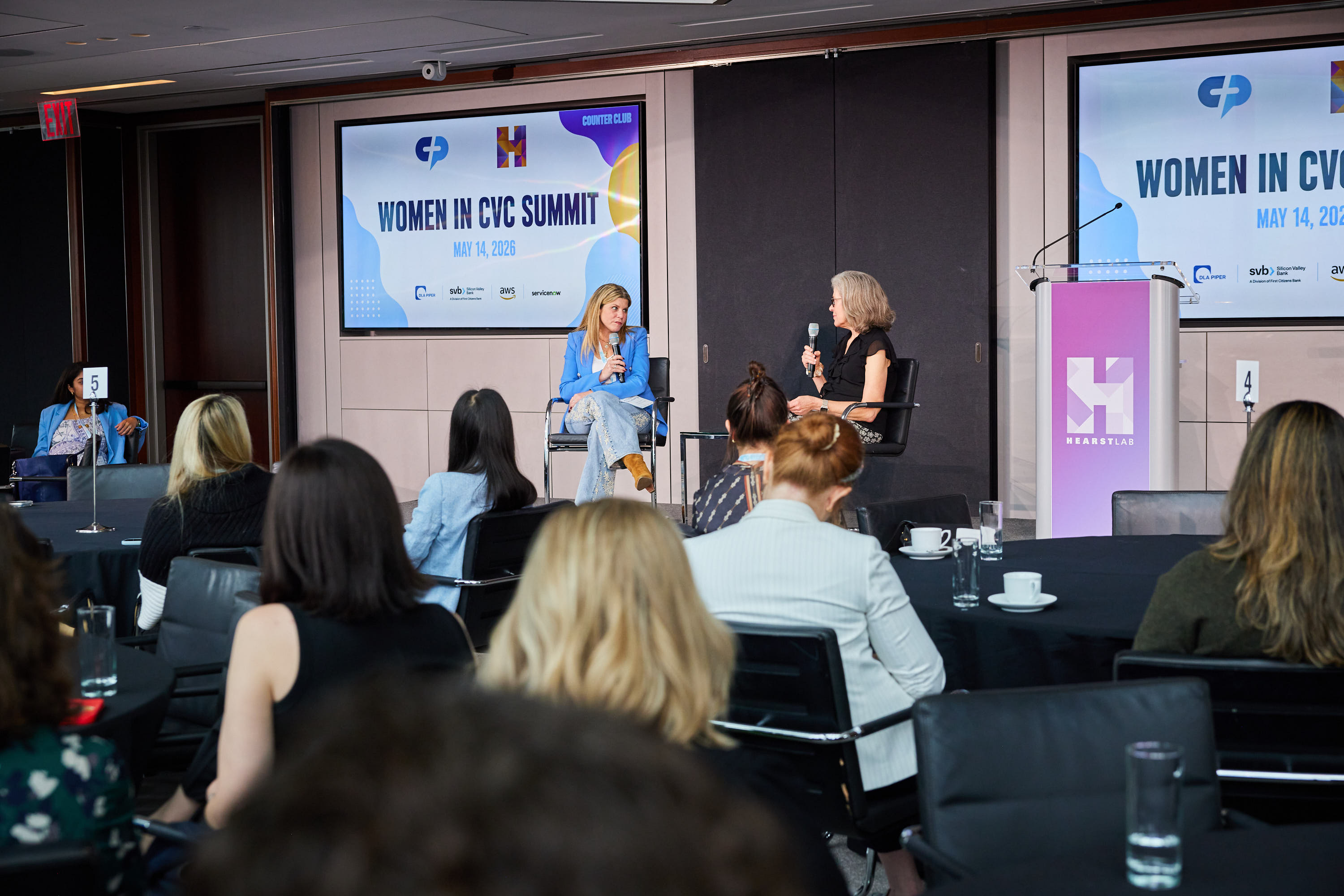
Our Fourth Annual Women in CVC Summit, this time in the Big Apple with the HearstLab Team
205 attendees (CVC investors, partners, founders, and operators). One room at Hearst Tower. The only all-day event dedicated to women in corporate venture. We heard the kind of conversations that don’t happen often enough between corporate investors, traditional VCs, and founders. The conversations were candid, and a few themes kept surfacing: governance matters, distribution matters more than ever, and differentiation only matters when it is real.
Corporate Investors can find the full summary notes on counterclub.vc here in the resources section.
Allison Goldberg (SVP and Managing Partner, Comcast Ventures) set the tone early. Being a corporate investor means meeting the same bar as any financial investor, and then bringing more. The strategic mandate isn’t a substitute for investment rigor. It’s an addition to it.
Two things worth carrying into your own programs. Comcast doesn’t invest with M&A intent and doesn’t ask for acquisition rights. Founders respond to that. And there’s no single KPI for strategic impact. Comcast tracks introductions made, partnerships closed, and internal knowledge-sharing as proxies. Making the strategic contribution visible is an ongoing effort, not a solved problem. Being present when a company is struggling is what founders remember.

Jessica Lin (Co-Founder and General Partner at Work-Bench) has been running a concentrated enterprise software fund in New York for 12 years. Her view: product & tech differentiation is compressing, while go-to-market may be the durable advantage companies can have.
A company that felt defensible two or three years ago is now seeing faster-moving competitors enter their space. What’s harder to replicate is distribution: the relationships, the sales execution, the trust built through a long enterprise cycle, and the stickiness created once the product is deployed.
For CVCs, the implication is clear. Your ability to accelerate a commercial deal is real leverage, but it works best when the founder already has a proven solution, a strong sales message, and the ability to deliver value quickly. You’re amplifying something that exists, not creating it from scratch.

Beth Ferreira (General Partner, Serena Ventures) described what most people in the room already feel: venture has gone from collegial to a knife fight.
For CVCs, that creates a real opening. Enterprise introductions, brand access, and distribution support are tangible assets a multi-stage fund can’t replicate. But the value must be real and delivered with minimal friction precisely. At Serena Ventures, the network is the asset, and Beth’s job is knowing exactly when to use it. When done right, a founder is matched with someone who gets their solution and is ready to act on their behalf.
This type of differentiation also pertains to investors being there when things get tough, e.g., cash is short, a founder loses an important client, and team challenges. Partners who disappear during a difficult quarter don’t stand out and they won’t be contacted for the next deal.

Becky Steinthal (Head of TMT Equity Capital Markets, Jefferies) has taken tech companies public for twenty years. Her read on 2026: the pendulum has swung fully to buyers. Strong IPO demand, a large backlog of companies that have waited too long, and investors who are finally picking individual stocks again.
The most common mistake she sees is conflating investor enthusiasm with investor conviction. They are often not aligned in a market where valuations are live on Bloomberg every minute. Companies that start with a lower valuation and build shareholder value over time consistently outperform those chasing the last dollar upfront.
The takeaway for portfolio companies: patience is not a weakness in this environment. It’s the strategy.

Carla Harris (Former Vice Chairman, Morgan Stanley) and Eve Burton (Chairwoman, HearstLab) closed the day with a conversation that was practical in the best way.
HearstLab works because it isn’t just a fund. It’s a platform with a mission: real commercial access, genuine knowledge sharing, and a long-term posture toward founders. That model is a natural fit for what Women in CVC has been building: a community where corporate and traditional investors share openly and honestly what works and what does not. When Carla saw the HearstLab model, she adapted it for Morgan Stanley. That replication is the proof of concept.
For founders with a corporate investor on the cap table: stop hiding problems. The resources exist to help. Using them is the point. On career development, Carla’s framing of sponsorship is worth internalizing at any stage. Every major decision about your career happens in a room where you’re not present. Building relationships before you need them is the strategy.
The evening ended with founder matchmaking. Corporate investors who spent the day on cap table strategy and exit timelines sat across from people who are building tomorrow’s products and solutions. The mix of candor, practical insight, and cross-network access is what made this year’s summit stand out.
We are an SF-based VC fund investing in B2B AI startups at Seed - Series B. We help build companies by providing meaningful access to real customers and strategic partnerships via our corporate venture capital community called the Counter Club. If you are corporate investor, we request that you create an account (https://counterclub.vc/signup) to access all events, content, and networking opportunities with others in the ecosystem.
HearstLab is a mission-focused corporate venture fund dedicated to closing the gender gap in VC by investing in early-stage women-led technology startups. In addition to strategic capital and hands-on support, HearstLab provides access to a global network of women executives. Hearst’s ecosystem of 360+ businesses includes iconic consumer media brands like Cosmopolitan, ESPN, and A+E, as well as a range of B2B software and data companies across healthcare, finance, and transportation industries including Fitch Ratings.
.svg)